
µTLS · Secure communication
Secure communication. Built for constraints.
µTLS brings device identity, encryption and efficient data exchange to constrained IoT hardware. Build the application your customers need, with a communication layer designed for limited bandwidth, power and memory.
Designed around device constraints
A smaller communication footprint.
µTLS (microTLS) is RIoT Secure’s patented communication protocol for constrained microcontrollers and embedded systems. It combines protected device-to-backend communication with efficient data encoding, helping teams work within limited bandwidth, power and memory budgets.
Protected by US Patent 11,997,165 B2, the protocol can reduce communication overhead by up to 95% compared with MQTT over TLS. The reduction depends on the payload and communication pattern. Less overhead leaves more of the available connection for application data.
Communication security
Identity, trust and protected messages.
µTLS handles device identification, trust establishment, key exchange, encryption and integrity verification between the device and backend. The communication layer takes responsibility for these mechanisms, so application developers can focus on the data their product needs to exchange.
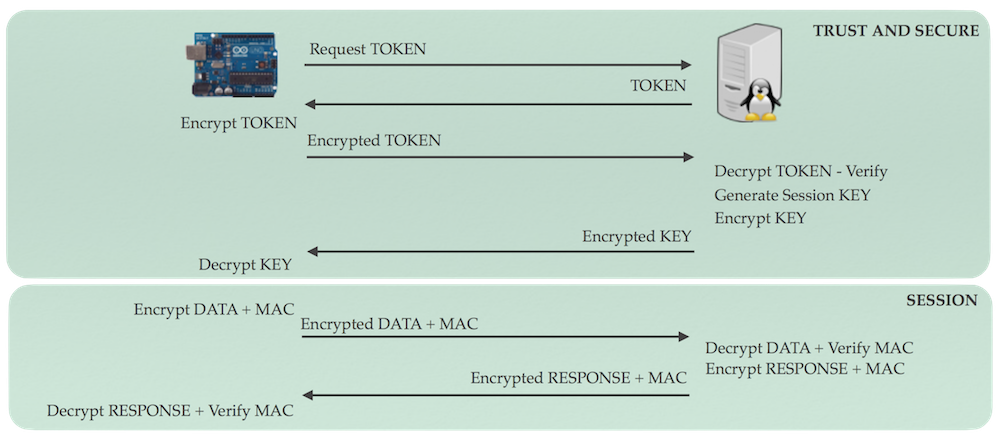
µTLS follows familiar secure-communication principles through a purpose-built protocol for embedded systems. It is a distinct protocol, rather than a lightweight implementation of standard TLS. The token exchange below shows trust establishment followed by an encrypted session, with message authentication codes used to verify data and responses.
Memory, power + bandwidth
Make room for your application.
Security needs to fit the device that will run it. µTLS is designed for low-power microcontrollers, limited memory and narrow communication links, rather than assuming the resources of a general-purpose computer.
Established cryptographic algorithms are adapted and optimised to limit code size and memory use. Developers can select the algorithms suited to their target hardware, while the modular approach allows additional algorithms to be introduced as requirements evolve. This keeps communication security part of the long-term device design.
Transport flexibility
Keep the connection. Add the security layer.
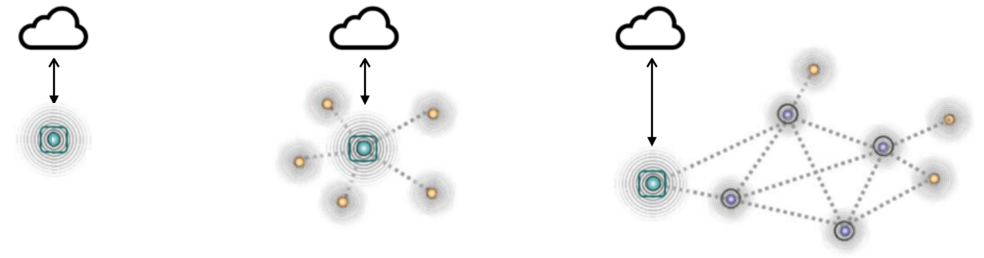
µTLS works over a bidirectional data stream, independently of the underlying transport. The protocol supports TCP/IP, serial connections such as RS-232 and TTL, 6LoWPAN, Zigbee, Bluetooth Low Energy, RF and proprietary radio links.
This allows the same communication approach to serve direct device-to-backend connections, sensor meshes and gateway-based networks. µTLS complements the connectivity and security already provided by the network, adding protection between the device and the RIoT Secure backend.
Developer integration
Two callbacks. One defined interface.
µTLS uses familiar embedded development patterns, including those used in Arduino-based environments. Two callbacks handle message creation and response processing, while the protocol manages the underlying security exchange.
The application retains its own logic behind a small communication interface. Keeping those responsibilities separate supports predictable behaviour and long-term maintenance for devices expected to remain in service for years.
Create the message
Provide the application data that needs to be sent.
Process the response
Handle the returned data in your application.
Part of the RIoT Secure platform
Communication for the whole lifecycle.
µTLS provides the communication foundation for device provisioning, lifecycle commands, over-the-air software delivery and fleet management. The same layer supports device data exchange and the operational messages needed to maintain a deployed fleet.
Within the platform, Fusion provides physical separation between the application and communication MCUs, Oasis manages the fleet and integration, and Brawl provides an execution environment for portable WebAssembly applications, with Shield adding application protection. µTLS connects the device to the backend across these supported configurations.
Plan your integration
Build secure communication into your device.
µTLS — patented security, engineered for the realities of embedded IoT.